A Digital Corporation is a Digital World organizational model for running a business, cooperative, or professional venture, with built-in tools for governance, permissions, credentials, communication, and services. It is not a legal entity by itself - legal recognition depends on the laws of the jurisdiction where you operate.
A Digital Corporation gives your business or venture a shared structure for governance, membership, permissions, credentials, communication, and services - built on the same identity system used across Digital World.
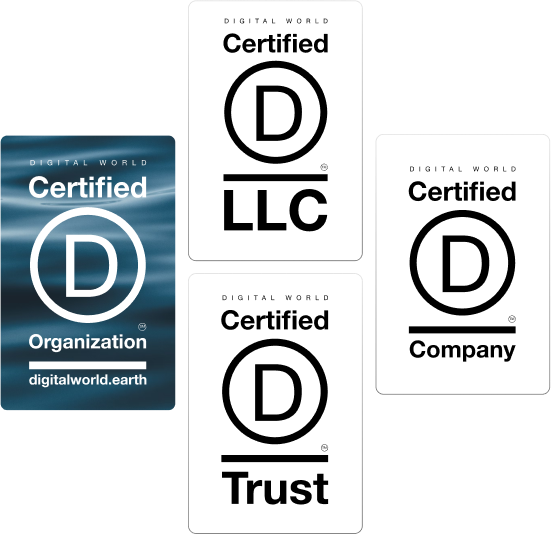
Governed
Certified
Registered
Licensed
Permitted
Labels such as "Governed," "Certified," "Registered," "Licensed," and "Permitted" are examples of governance or organizational states within the Digital World platform. They do not imply legal recognition, regulatory approval, or government certification.
These are the core capabilities every Digital Corporation is built on.
Decisions are made through rules the corporation defines, such as voting, officer approval, or delegated authority.
Defined roles determine what each member or officer can do on behalf of the corporation.
The corporation has its own Digital Identity, separate from the personal identities of its members.
Access can be granted, reviewed, and revoked for members, services, and agents acting on the corporation's behalf.
Actions taken on the corporation's behalf are tied to a verifiable role, so responsibility can be traced.
Day-to-day administration - membership records, roles, and settings - managed from one place.
Running a business or formal venture usually means separate systems for membership records, governance, permissions, and communication. A Digital Corporation brings these into one place, using the same identity and credential system as other Digital World organizations:
One shared record of who is a member, officer, or stakeholder, and what authority each of them has.
Governance rules your corporation defines itself, rather than a generic default.
Verifiable credentials your corporation can issue to members, such as roles or certifications.
Direct communication tools for members and officers, without relying on outside platforms.
From setup to day-to-day operation, here's the workflow for a Digital Corporation.
Register your corporation and set up its own Digital Identity on the network.
Define how decisions are made and the roles members and officers can hold.
Bring in members and officers, and set what each of them is permitted to do.
Connect your corporation to the participating services and providers it needs to operate.
Any group running a formal venture can use a Digital Corporation to manage governance and operations.
Manage ownership, operations, and customer-facing services under one governance structure.
Set up governance and roles early, and adjust them as the founding team and structure grow.
Formalize membership, officer roles, and decision-making for mission-driven work.
Run member-owned governance where decisions and permissions are shared among members.
Manage membership, credentials, and standards for a professional body or association.
Every Digital Corporation defines its own roles and the authority that comes with each one. Typical roles include:
Typically holds initial authority to set governance rules, assign officers, and register the corporation's identity.
Assigned specific authority to act on behalf of the corporation, such as managing services or issuing credentials.
Participates in the corporation according to the rules and permissions the corporation defines.
Holds permissions delegated by another role for a specific task or period, which can be reviewed or revoked.
Disclaimer: A Digital Corporation is a Digital World organizational model. It does not automatically create a legal corporation, legal business entity, or regulatory status, and it does not by itself grant limited liability, tax status, or other legal protections. Legal recognition depends on the applicable jurisdiction and remains the responsibility of the organization and its founders. Nothing on this page is legal, financial, or investment advice.
No. A Digital Corporation is an organizational model on Digital World. It can be used alongside a variety of legal structures - such as a conventional corporation, LLC, cooperative, nonprofit, public-benefit company, or unincorporated association - but forming any of those legal entities is a separate process governed by the laws of your jurisdiction.
Any member with a Digital Identity can register a Digital Corporation, including businesses, startups, nonprofits, cooperatives, and professional organizations.
A Digital Corporation itself does not provide a fundraising or securities mechanism. If you intend to raise capital or issue equity, you're responsible for complying with the securities and corporate laws that apply to you.
Yes. Roles and permissions can be reviewed, reassigned, or revoked by whoever holds the authority to manage the corporation.
A Digital Organization is the general umbrella, covering associations, communities, companies, DAOs, trusts, and country structures. A Digital Corporation is one specific, more formal structure within that umbrella, intended for businesses and formal ventures.
Register a Digital Corporation to manage governance, roles, and services in one place, or explore Digital Organizations to find the structure that fits your group.